Process Improvement · Prototype
Römiz Analiz
Digitalizing trade document processing with OCR and AI
The work was carried out on 23 publicly available sample remittance letters; it contains no real customer documents, confidential information or internal system screens.

- %99accuracy extracting key data across 23 sample remittance letters
- 6automated capabilities: document type, original/copy, counts, remittance detection and more
- 5stage, measurable pilot plan
- İnsan + AIthe final check always stays with the operator
The current process
Trade documents arrive at the unit physically, as a package. In each package, documents are reviewed one by one, document types are identified, originals and copies are separated by hand, counts are checked, and key data on remittance letters and other documents is read and entered into the system manually.
This attention-heavy, repetitive and largely manual process naturally carries a risk of error.
The opportunity
Receiving documents electronically isn't always possible. So instead of changing the physical flow, my proposal digitalizes it through a scanner:
Physical documents → Scanning → AI-assisted document analysis → Operator check → System data entry
The goal isn't to take people out of the process, but to make their work faster, more controlled and less error-prone.
Remittance analysis flow
In the MVP, the remittance letter is scanned, analyzed with AI and OCR, its document type is verified, and key fields are structured and shown to the operator with a confidence score. High-confidence fields are ready to use; low-confidence or unreadable ones are routed to the operator for review.
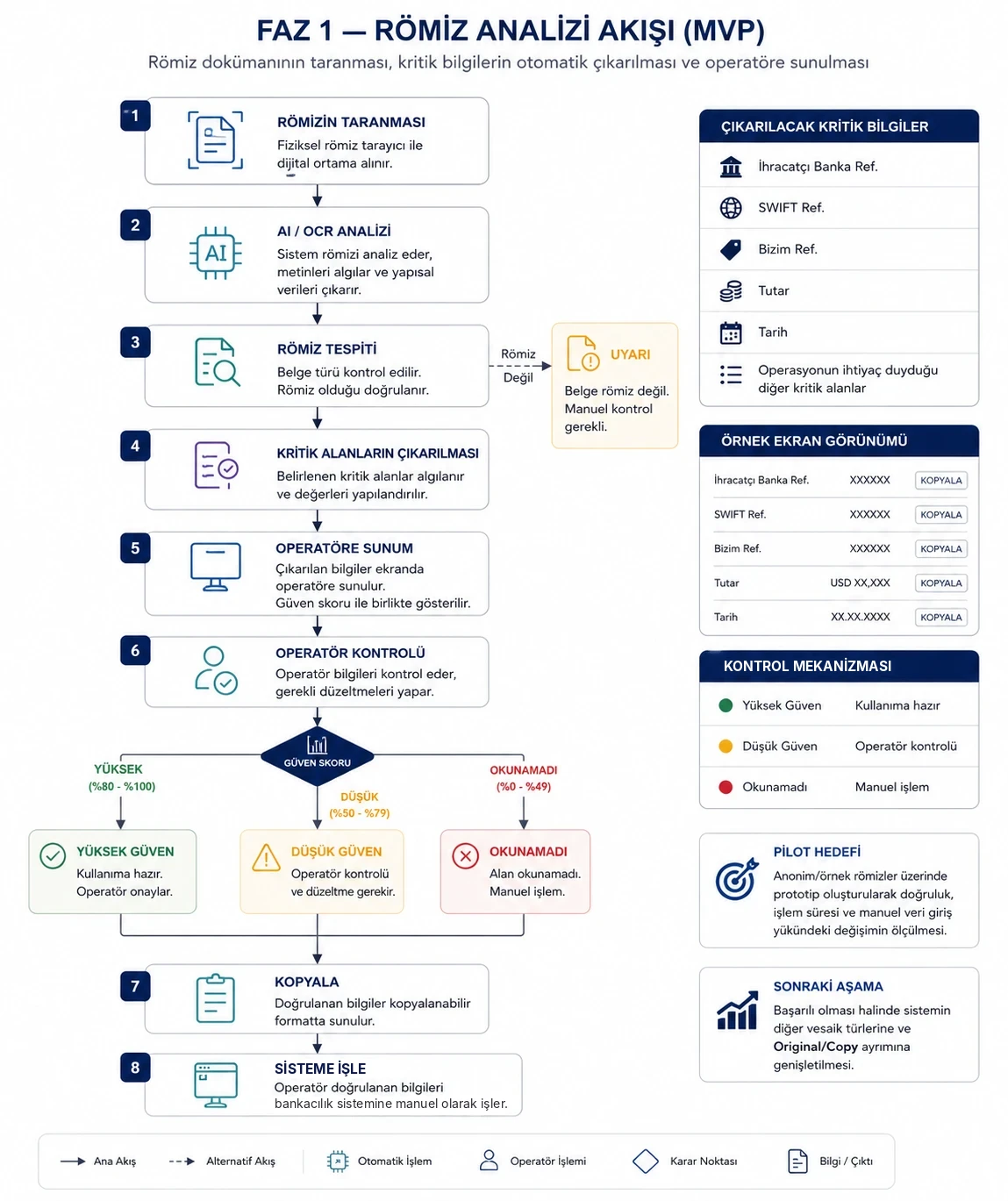
Proposed system: Smart Document Analysis
The whole document package is scanned in one pass. The system recognizes remittance letters, bills of lading, commercial invoices, certificates of origin and packing lists, then:
- Detects the document type.
- Separates originals from copies.
- Counts each document type.
- Automatically recognizes the remittance letter.
- Extracts its key data: exporter bank reference, SWIFT reference, amount, date.
- Presents results to the operator in a verifiable, copy-ready format, highlighting the file's status in a "key notes" summary.
Expected benefits
- Operational efficiency: fewer repetitive manual steps and shorter processing time.
- Lower error risk: fewer mistakes from reading and retyping references and amounts.
- Standardization: original/copy separation and classification move to a consistent structure.
- Operator support: staff entering data reach the right information faster.
- Control: low-confidence fields are verified by the operator.
Pilot proposal
- Build a prototype with anonymized sample documents.
- Test document type and original/copy separation.
- Test automated extraction of key remittance data.
- Measure processing time and error rate against the current process.
- If results are positive, evaluate integration with the existing system.
Outcome
In my tests on 23 publicly available sample remittance letters, key data was extracted with 99% accuracy. Aiming for less manual work, faster data entry, lower error risk and a more standardized document review, I presented the work to my unit manager and brought a new perspective on how the process could run more effectively.